



Building with the forest: Van Gujjar shelter construction traditions
In the lower and middle Himalayas, the Van Gujjars have refined a shelter tradition that bends with the seasons rather than fighting them. For centuries, these pastoralist communities have built homes that match the rhythm of buffalo migration between the Shivalik foothills and high-altitude meadows, drawing on deep knowledge of local timber, climate, and ecology.
In a country like Australia where housing affordability in Sydney and Melbourne sparks constant debate, the Van Gujjar approach offers a refreshing counterpoint to bricks-and-mortar thinking. These low-impact, repairable dwellings raise timely questions about what shelter really needs to be, and how Indigenous knowledge can inform modern sustainable design.
Materials sourced from the forest
Van Gujjar shelters are built almost entirely from forest produce gathered under permits granted through forest rights claims. The main poles come from straight-stemmed species such as sal, semal, and local bamboo clumps, while smaller branches and saplings form the lattice for walls. Split timber planks are laid across joists, often raised slightly above ground to keep interiors dry during monsoon downpours.
The Van Gujjars select wood for flexibility and decay resistance rather than appearance, choosing poles seasoned in the forest rather than kiln-dried. This material logic shares something with remote stations in the Kimberley and Top End, where homesteads have long relied on locally milled cypress or ironwood. The principle is simple: build with what grows nearby, and the building breathes with its place.
Structural framework and joinery
The framework of a typical Van Gujjar shelter rests on four to six main uprights, set into the earth without concrete footings and braced by diagonal struts that resist monsoon winds. The lack of permanent anchoring is intentional, allowing the entire structure to be dismantled and re-erected within days.
Joinery relies on rope lashings made from local bark fibre, twisted into cords that bind horizontal beams to vertical posts. Metal nails are uncommon; only occasionally do families use a handful of salvaged iron pieces for added security. Visitors familiar with bushcraft workshops in rural Queensland or off-grid builds near Hobart will recognise this shared logic of disassembly, repair, and full recovery of components after a hard season.
Roof construction and thatch work
The roof is the most labour-intensive part of any Van Gujjar dwelling. Long grass, often kharkhas from forest clearings, is bundled and tied over a bamboo grid and layered from the eaves inward, sometimes reaching 15 centimetres of compressed thatch.
Bark sheets from the semal tree sometimes act as a natural water-shedding underlay, pinned against the ridgepole with weighted logs. The system sheds snow at altitude and monsoon rain down low without synthetic underlay or bitumen. In South Australia, heritage-listed buildings in Hahndorf and along the Adelaide Hills still showcase Germanic thatching, while permaculture farms near Brisbane revive grass roofs. The parallel is clear: a well-built thatch roof outlasts many contemporary materials.
Floor, walls, and weatherproofing
Walls are typically woven panels of split bamboo or reeds, lashed into rectangular frames that slot between the structural uprights. Inside, an earthen or cow-dung plaster is sometimes applied, sealing the weave and softening the interior light. The mixture is renewed annually, a maintenance ritual tied to the pastoral calendar.
A small hearth occupies one corner, with smoke escaping through a ridge gap. Floors are swept clean and layered with fresh pine needles, acting as both insulation and insect repellent. During winter migrations, families hang woven mats across doorways to block wind.
Seasonal mobility and reassembly
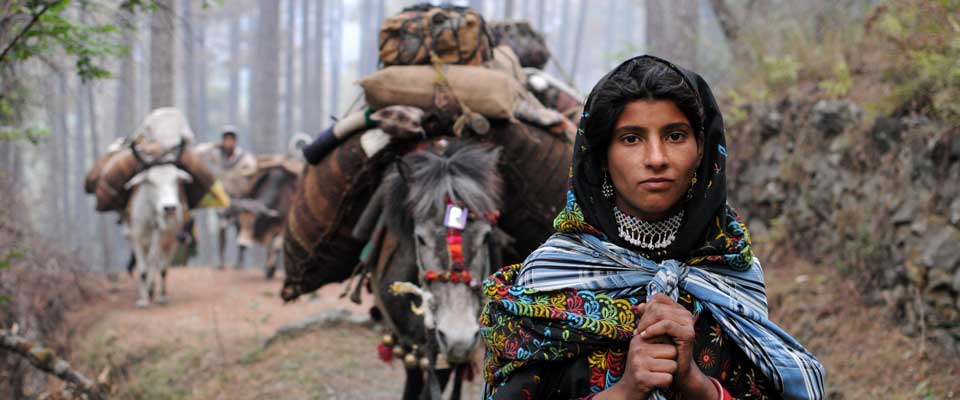
Mobility is woven into Van Gujjar shelter design. Each spring, families move with their buffalo herds from the Shivalik lowlands toward summer pastures around 2,000 to 3,000 metres. Their shelters travel with them, packed onto the same donkeys and bullocks that carry household tools and milk vessels.
Reassembly is a community event. Men set up the main frame while women weave fresh wall panels and bundle fresh grass for the roof. Children learn the sequence early, mastering lashings before handling full workloads. The migratory logic behind these structures is documented on the Van Gujjar nomadism traditions page, which explains how mobility and shelter are inseparable cultural practices.
Communal labour and knowledge transmission
Building a Van Gujjar shelter is rarely a solo task. Neighbouring families gather to fell poles, split bamboo, and haul thatch, sharing meals and music through the work. Housing is treated as a collective responsibility rather than a private transaction.
Skills pass informally from elders to younger relatives, particularly during long winter evenings at high-altitude pastures. Children accompany parents to identify the right poles, learn which grasses cure well, and practise lashings that hold a roof together in storm winds. This grassroots mentoring has parallels in Aboriginal ranger programs across the Top End and Cape York, where senior custodians guide young people in fire management and traditional land-care.
Relevance to contemporary sustainable design
Architects and permaculture designers worldwide are turning to vernacular traditions for inspiration. The Van Gujjar shelter offers lessons in low embodied energy, seasonal adaptability, and regenerative materials. Its thatch roof stores carbon, its timber framework sequesters carbon for decades, and its full lifecycle returns nutrients to the forest floor.
The lessons translate well to bush settings outside Darwin, Tasmania's east coast, or rural properties west of Perth. Tiny homes and earthbag construction in the Byron hinterland and the Adelaide Hills already draw on similar lightweight, low-impact principles. The Van Gujjar example reminds us that shelter can be a relationship rather than a structure: when materials are sourced nearby, when maintenance is a seasonal ritual, and when mobility is built into the design, the dwelling becomes part of the landscape rather than an imposition upon it.
SOPHIA's work supports these communities as they assert forest rights and protect mobile pastoral livelihoods, and there are meaningful ways to engage from Australia. Sharing this article with networks interested in Indigenous knowledge, supporting the organisation's documentation projects, or offering expertise in sustainable design, photography, or community development can all make a difference. Even a simple conversation about how we build, where we build, and why we build can carry the spirit of Van Gujjar tradition a long way.