




Buffaloes as Silent Engineers of Soil and Forest Renewal
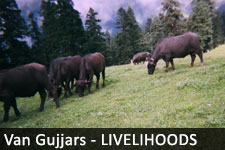
Across the Himalayan foothills, large ruminants shape forests in ways satellite imagery rarely captures. Their droppings and grazing patterns rewrite the chemistry of the forest floor, weaving nutrient cycling, seed dispersal, and micro-site creation. For Van Gujjar pastoralists, these animals are active partners in the ecology sustaining seasonal migration routes.
Modern farming has separated livestock from forests, treating soil fertility as a problem for synthetic inputs. Yet silvopastoral research shows that well-managed herds accelerate exactly the processes — organic matter build-up, mycorrhizal activity, water infiltration — that bagged fertilisers merely mimic.
This perspective runs through SOPHIA's work in Uttarakhand, Himachal Pradesh, and Uttar Pradesh, where buffalo husbandry underpins sustainable pastoral livelihoods. SOPHIA backs Himalayan village communities in protecting forest and domicile rights, framing pastoralism as a land-use pattern that regenerates rather than depletes the commons.
The role of buffaloes in soil fertility and forest regeneration offers a useful frame for thinking about Australian pastoralism too. Across Queensland, New South Wales, and the Northern Territory, debates over grazing pressure, vegetation clearance, and carbon farming dominate rural policy. Understanding how buffaloes build soil and seed banks in one hemisphere sharpens the lens for the other.
The Nutrient Cycle Beneath the Herd's Feet
Buffalo dung is a slow-release fertiliser rich in nitrogen, phosphorus, potassium, and microbes. Where the herd rests beneath sal or oak canopy, the soil receives a concentrated infusion of organic carbon that feeds earthworms, beetles, and fungal networks.
Around Moree and Longreach, dung beetles — many introduced from Africa to break down cattle pats — have transformed nitrogen cycling and reduced fly pressure. In the Himalayas, buffaloes move between winter lowlands and summer alpine pastures, spreading fertility across vertical gradients chemical application will never match.
Hoofprints as Micro-Sites for New Growth
Each cloven step opens a thin fracture in crusted soil, exposing mineral layers and creating a depression where rain can pond rather than run off. Wind- and bird-dispersed seeds fall into these reservoirs, finding moisture, shade, and reduced competition.
Studies from Spain's dehesa to Kerala's home gardens confirm moderate trampling lifts tree seedling survival compared with ungrazed plots. Buffaloes, heavier than sheep or goats, break through thatch and press seeds into mineral contact. Van Gujjar rotational grazing produces exactly this dynamic — SOPHIA teams have observed banj oak and ringal bamboo naturally regenerating in vacated paddocks.
Seed Dispersal Through the Digestive Journey
Many forest plants rely on animals to move seeds, and buffaloes are effective vectors. Wild fig, amla, and acacia seeds pass through the four-chambered stomach and emerge viable inside ready-made compost. Germination rates rise for some species, as scarification breaks tough seed coats.
In the Australian bush, emus, kangaroos, and cattle play comparable roles. Quandong seeds travel in macropod guts, and prickly pear once spread via cattle before Cactoblastis moths arrived. Restoring dispersal pathways is funded under the Environment Protection and Biodiversity Conservation Act 1999. The Himalayan buffalo, meanwhile, transports seeds kilometres in a single day, well beyond wind or birds.
Buffaloes as Forest Architects in the Foothills
In the buffer zones of Rajaji and Corbett, where forest rights movements have intensified, the Van Gujjar buffalo functions as far more than a commodity. Grazing patterns create a patchwork of open glades and dense thicket, supporting chital, sambar, and the Bengal florican. Removing the herd entirely has often led to thicket encroachment, fire vulnerability, and loss of the very species closures were meant to protect.
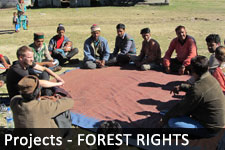
SOPHIA's engagement with state forest departments draws on this lesson. It advocates community-led grazing plans matching herd size to forage availability, protecting sapling zones during dry months, and maintaining corridors between seasonal pastures, aligned with India's Forest Rights Act 2006.
The Australian analogue lies in Aboriginal pastoral enterprises and Indigenous ranger groups across the Top End and Kimberley, managing fire and grazing together. Both contexts treat herders as land stewards, not users competing with conservation.
Soil Carbon, Water Retention, and the Living Soil
Healthy dung-enrichment gives soils a sponge's capacity, releasing water slowly through dry spells. In the lower Shivaliks, where downpours arrive in violent bursts, infiltration on buffalo-grazed ground measurably exceeds bare plots. That moisture feeds springs downstream villages depend on.
Carbon storage follows. Organic matter from dung, leaf litter, and root turnover accumulates in pastoral woodlands at rates that could, if verified, support payments for ecosystem services. Australia's Emissions Reduction Fund includes methodology for soil-carbon projects in the rangelands; similar frameworks for South Asian pastoralists remain an open conversation. The soil microbiome — methanotrophs, mycorrhizal fungi, dung beetles — closes the loop.
A Pastoralist Commons Across Two Hemispheres
Pastoralists across the Indian subcontinent and the Australian outback face parallel challenges: contested tenure, development, climate volatility, and the erosion of customary knowledge. The Van Gujjar buffalo and the Brahman-cross cow of the Kimberley rangelands navigate landscapes official maps struggle to classify.
Riverine buffalo farming has quietly grown in northern Australia, with milk producers near Darwin and on the Atherton Tablelands supplying niche cheese markets. Specialty outfits in Victoria have scaled buffalo mozzarella, and weekend farmers' markets in Melbourne, Brisbane, and Adelaide now stock buffalo milk.
Australian research linked to Landcare and the federal Reef Programme confirms what SOPHIA field workers witness: dispersed grazing animals, given room to move, repair rather than degrade landscape function. Indian policy can draw on Australian carbon-credit experience; Australian regenerative advocates can find in the Van Gujjar a resilient, rights-based model of herding that has endured for centuries without synthetic inputs.
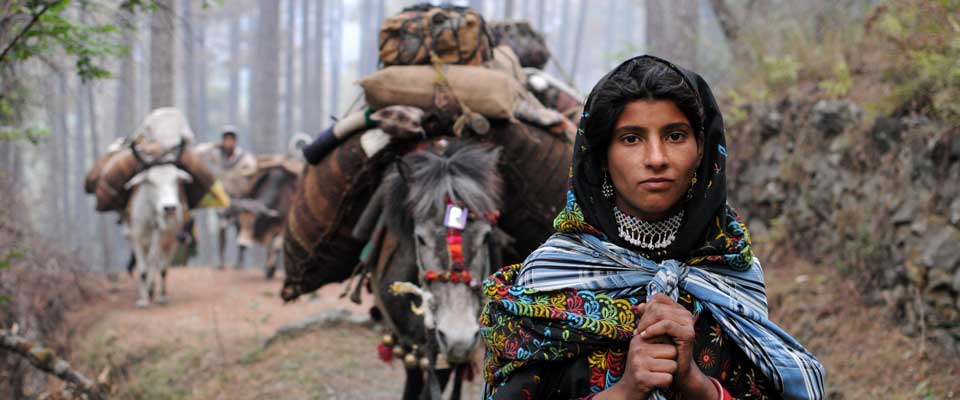
A winter Van Gujjar encampment is partly smoke, partly song, partly the rhythmic clatter of milking buffaloes returning to their shelters. To stand there is to glimpse sustainable pastoralism rooted in community, custom, and ecological intelligence. SOPHIA's work keeps that picture visible to policymakers and supporters alike.
Readers interested in pastoralist futures — from a flat in Carlton, a station near Cobar, or a weekend stall at Queen Victoria Market — can start by exploring the project pages and photo archive. Partnership enquiries, volunteer placements, and donations are welcomed via the Get Involved section, strengthening the rights and livelihoods of Himalayan communities committed to a forest-friendly future.